
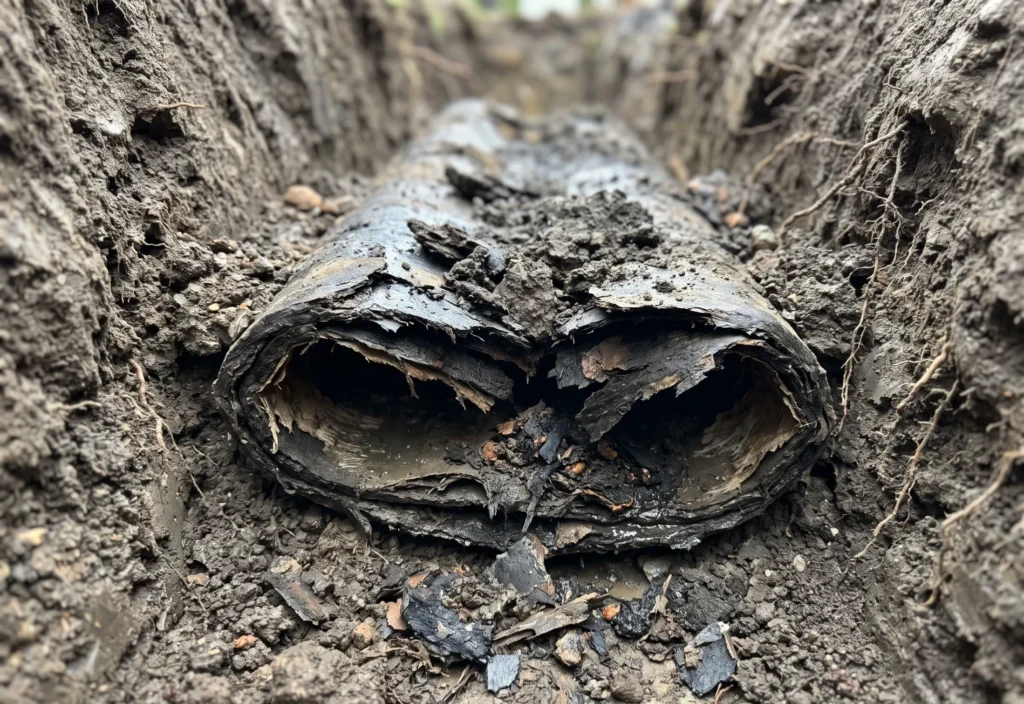
Most buyers touring a mid-century Washington home check the roof and electrical panel but overlook the main sewer line. In homes built from the mid-1940s through the early 1970s, the sewer line may be Orangeburg: a lightweight pipe made from layered wood fiber bonded with coal-tar pitch.
Decades of moisture and soil load can soften, deform, or collapse these legacy lines. Because deterioration is often widespread, replacement is frequently the durable solution, but the right approach depends on a camera inspection. For severely crushed lines, Orangeburg pipe repair often requires excavation.
Can You Patch or Repair an Orangeburg Sewer Pipe?
Not reliably. Once Orangeburg becomes severely deformed, delaminated, or collapsed, patching, sleeving, or lining is usually not a lasting solution. In limited cases, lining may be considered only when the pipe still retains a sufficiently round, stable cross-section.
Orangeburg often deteriorates across a section rather than failing at one isolated joint. Long-term moisture exposure and wastewater contact can degrade the coal-tar binder that helps protect the fiber layers.
As the binder deteriorates, moisture can reach the fiber layers, contributing to softening and delamination. The layers can separate and deform inward, reducing the pipe’s interior capacity. As the material loses strength, soil load can deform the pipe from round to oval and, in severe cases, restrict or block flow.
Aggressive mechanical cleaning can damage deteriorated Orangeburg, so technicians should assess the line before choosing a clearing method. A cable may restore temporary drainage, but it does not repair the weakened pipe wall.
Identifying Failing Orangeburg Pipe in Older Homes
Many homeowners discover Orangeburg during a backup, sewer inspection, or home purchase. A camera inspection is the reliable way to confirm the pipe material and assess its condition.
Watch for these warning signs that an Orangeburg line may be deteriorating:
- Dark, Fibrous Residue: Material on a drain cable can suggest deteriorating Orangeburg, but it is not a definitive diagnosis.
- Blistered or Delaminating Walls: A sewer camera may show softened, peeling, or deformed inner walls.
- Ovaling or Flattening: A pipe that has lost its round shape may be weakening under soil load and may be close to collapse.
Significant deformation indicates seriously compromised structural capacity. The camera findings help determine whether cleaning, lining, pipe bursting, or excavation is appropriate. A full camera inspection also documents the pipe’s material, interior condition, slope, and location of roots, offsets, or low spots. That record helps the contractor determine whether the line remains round enough for lining, has a usable path for pipe bursting, or has collapsed far enough to require excavation and replacement.
Why No-Dig Solutions Fail on Crushed Orangeburg
Trenchless methods depend on a usable path or sufficiently intact host pipe. When Orangeburg has fully collapsed, most no-dig options are no longer practical.
- Blocked Tooling Path: Pipe bursting needs a passable route for the cable or rod. A fully collapsed or dirt-filled run may leave no usable path for the equipment.
- Lining Cannot Restore Shape: CIPP cannot restore a severely flattened or collapsed pipe to a round shape. A liner installed in a significantly deformed pipe may cure to a restricted profile and fail to restore adequate capacity.
- Loss of Gravity Grade: A collapsed or deformed section can create a low spot or belly that restricts drainage. Excavation may be needed to remove failed material, rebuild bedding, and restore proper grade.
Attempting a trenchless repair through a collapsed run can lead to incomplete installation or a change to excavation. When an Orangeburg line has collapsed shut, excavation is often needed to restore grade and install a durable replacement pipe, such as PVC.
Related Articles:
- What Is Orangeburg Pipe & How Do You Replace It in Tacoma?
- Why Spot Sewer Repairs Do Not Work on Tacoma Orangeburg Pipes
Replace Failing Orangeburg Today
Ignoring slow drains in an older home is an easy way to end up with raw sewage backing up into your basement. Every tar-paper pipe still in the ground today is decades past its lifespan. Waiting until the line completely caves in turns a routine replacement into a messy, expensive weekend emergency.
Sewer Solutions digs up failed Orangeburg pipe and installs PVC to stop recurring backups for good. Contact Sewer Solutions today to inspect your line and schedule your Orangeburg pipe repair.